
The Women of My Country, the Women of the World
Aug 20, 2026
Story
Seeking
Visibility


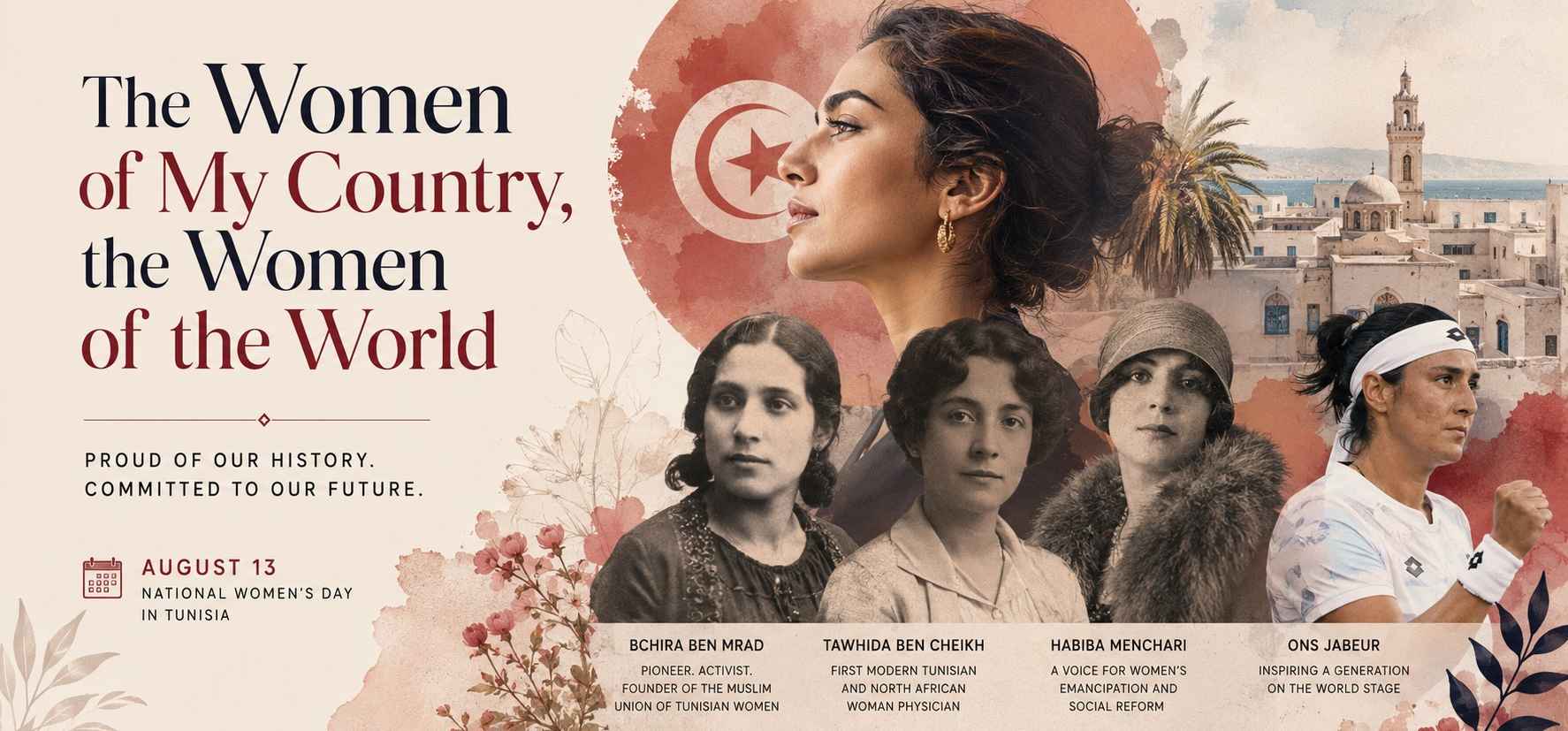
Photo Credit: AI generated image.
August 13 was National Women’s Day in my home country, Tunisia.
For me, it has always carried a certain sense of pride. I grew up knowing that being a Tunisian woman came with a particular history, one built by women who pushed boundaries long before many of the freedoms we have today could be taken for granted.
I come from a country that has long taken pride in its pioneering role in advancing women’s rights. Within Africa, the Arab-speaking world, and the broader Muslim world.
On August 13, 1956, only months after independence, Tunisia adopted its historic Personal Status Code. It abolished polygamy, established judicial divorce, required consent in marriage and fundamentally changed the legal status of women within the family. In the decades that followed, Tunisian women gained greater access to education, work and political participation.
But the story of strong Tunisian women did not begin with the laws that recognized their rights.
Long before the Personal Status Code, Tunisian women were already pushing against the limits imposed on them.
Habiba Menchari was one of them. She was publicly challenging conventions around women and their place in society as early as the 1920s.
Bchira Ben Mrad, in 1936, founded the Muslim Union of Tunisian Women, bringing women into both the struggle for their own emancipation and the wider fight for Tunisia's independence. At a time when women's place in public life was still deeply restricted, she fought for their education, their voices and their right to participate in shaping their country.
Then came women like Tawhida Ben Cheikh, the first modern Tunisian and North African woman physician, who broke barriers in medicine and devoted much of her career to women's health and family planning.
And in our own generation, Ons Jabeur carried the Tunisian flag onto some of the biggest stages in world sport.
Different women, different generations, different battles.
But when I look at them, I see something that feels deeply familiar to me as a Tunisian woman: a certain refusal to be confined to the space society has decided women should occupy.
Perhaps that is part of why I have always felt a particular pride in saying that I am a Tunisian woman.
We inherit more than the rights written into our laws. We inherit the struggles of the women who came before us. Women who spoke, studied, worked, organized, and challenged the boundaries of their time so that generations like mine could grow up expecting freedoms that were once anything but guaranteed.
But pride in our history should never prevent us from looking honestly at our present.
Because the story of Tunisian women today is not only a story of progress.
Tunisia has one of the region’s strongest legal frameworks protecting women. Yet domestic violence remains widespread. Women continue to be killed by husbands, former partners and family members. Some seek help before they are killed. Some report the violence. Some knock on the doors of the institutions that are supposed to protect them, only to find that the protection promised by law does not always exist in practice.
And there is something particularly painful about that contradiction.
To grow up being told that the women of your country are free, educated, protected by law and equal citizens… and then to watch women die at the hands of the people closest to them.
To know that some of them asked for help first.
What does a right mean if a woman is too afraid to exercise it?
What does protection mean if she asks for it and is sent home?
What does equality mean if violence against women is still normalized, minimized, or dismissed as a private family matter?
And this is where, for me, August 13 stops being only about Tunisian women.
Because these questions cross borders.
Across the world, women live inside versions of this same contradiction.
Our countries have different histories, cultures, religions, economies and legal systems. Some women have rights their grandmothers could barely have imagined. Others are still fighting for the most basic freedoms.
But everywhere, laws are only the beginning.
A right written on paper must become a right that a woman can actually live.
A law against violence must become a police officer who listens. A judge who acts. A family that believes her. A society that does not ask what she did to provoke him. A system that intervenes before her name becomes another statistic.
So every August 13, I celebrate the women of my country.
I celebrate the women whose courage made it possible for generations like mine to grow up expecting to study, to work, to choose our paths and to imagine lives beyond those prescribed for us.
I celebrate the women who came before us, the women standing beside us today, and the girls who will inherit what we leave behind.
But celebration should not mean complacency.
I also think of the women we failed to protect.
And beyond Tunisia, I think of the women of the world whose battles may look different from ours, but whose demand is ultimately the same:
Not simply to have rights, but to be able to live them.
Not simply to be protected by law, but to be protected in life.
Not simply to survive, but to be free.
To the women of my country, and to the women of the world:
I am proud of how far we have come.
But I hope we never become so proud of our progress that we stop seeing how far we still have to go.