
Kenya: When Systems Fail, Women Hold Down the Pieces
Aug 19, 2026
Story
Seeking
Encouragement


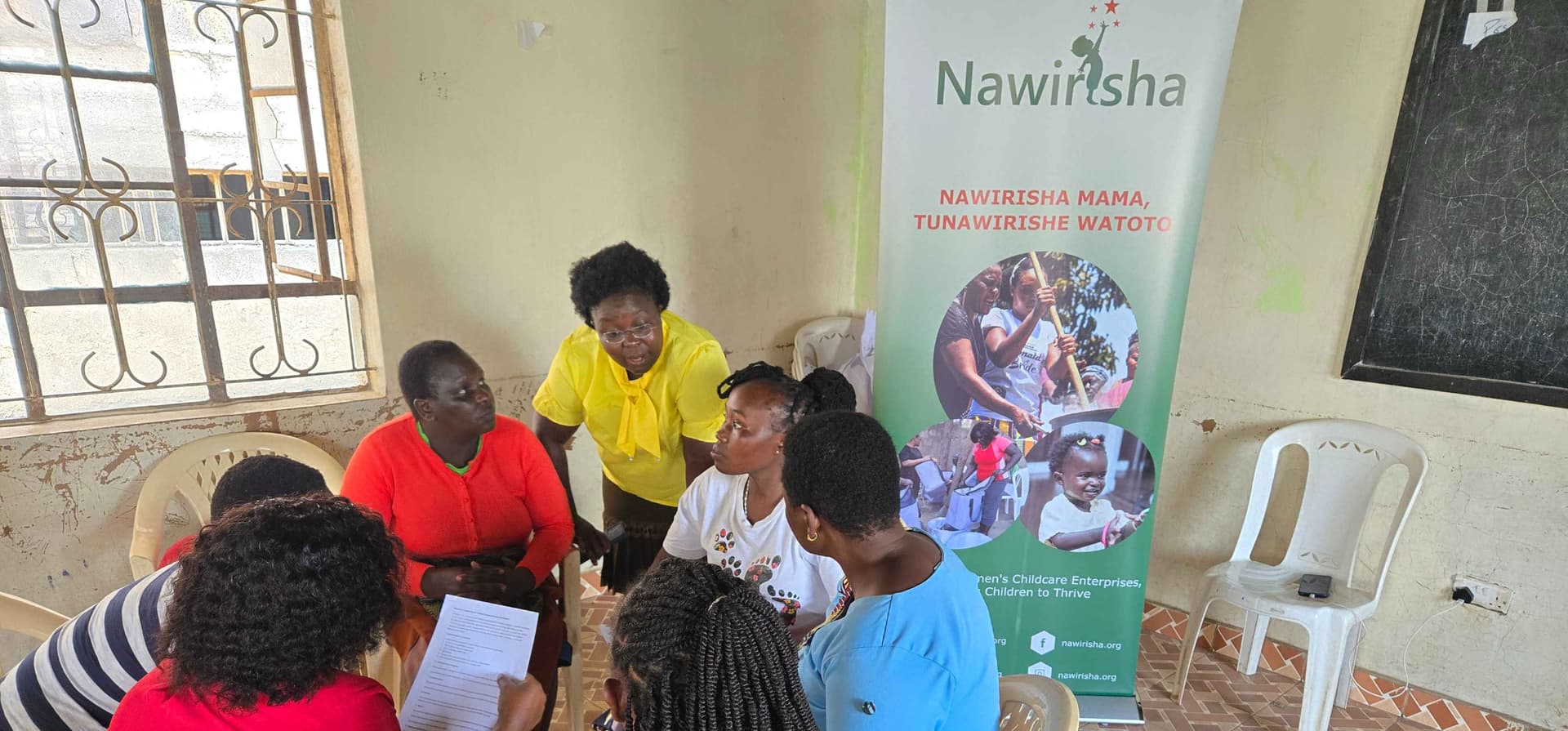
Photo Credit: Nawirisha Childcare Services Ltd.
Rose Awuor, a Nawirisha team member facilitating a Focus Group Discussion with women in Mathare
Tuesday, August 2026, it was a chilly Nairobi morning. I woke up and prepared to head out to Mathare, one of Kenya’s largest slums with an estimated population of over 500,000 people. My organization Nawirisha has been working here for at least 4 years now, supporting women informal childcare providers to improve childcare services. In what has truly been a rewarding journey, Nawirisha has collaborated with over 100 women informal childcare entrepreneurs, village elders and Chiefs to design and implement various solutions, including the Community-led Childcare Regulation Framework (Mama-Care Guidelines), meant to guide the provision of quality childcare services.
But on this day, however, I was heading out to Mathare for a different reason. Perhaps some of you might remember my 2023 article on the childcare food program we were testing during the drought that ravaged many of Kenya’s households. That year, we went on to have a successful ‘Test and Learn’ project despite the soaring food prices. However, we ended up getting so emotionally and financially drained, that we decided to pause the food program, to redesign and seek external funding. This also paved the way for the development of a community-led childcare regulation mechanism, to anchor the food program and other services we seek to offer.
Having secured a seed grant from The Giving Exchange, as part of their excellent “BLOOM” program supporting change-makers in East Africa to build self-sustaining organizations, I was excited to meet with a group of 20 kindergarten school founders in Mathare that day. The school founders had requested to join our Mama’s Lunch food program under special consideration. Originally, our food program aimed to provide freshly cooked and nutritious meals to informal childcare enterprises to improve children’s nutrition and secure women’s incomes. However, a growing number of kindergarten schools, whose daycare programs are represented in the program, kept asking if we could offer them affordable raw food supplies to cook for all children, instead of the younger ones only. Obviously, this presented a good opportunity for us to reach more children, besides increasing our sales revenue.
The meeting was going to be held at St John and Paul Catholic Church in Mathare. I can’t tell how much the church has been a critical pillar of our work in the community, as they often provide us with an affordable secure place to meet and train the women.
By 8.30 am, only one young man had arrived to represent his school’s director. My colleague Rose moved up and down, making calls to various participants who had confirmed attendance. As the day’s facilitator, I was quite curious to see the participants I would be engaging over a period of 3 hours. My aim was to help Nawirisha understand the participants’ needs for food and more, to inform our service offering. After an hour’s wait, seventeen kindergarten school founders and representatives had taken their seats at the venue. We prayed and officially began the consultation forum.
Standing in front of the group, a stream of thoughts flooded my mind. Despite the fact that our focus was food, I realized it would be a mistake not to dig deeper and know more about them. My quest would start with introductions. I requested the 17 participants to introduce themselves by sharing their name, school child population, ownership, and level it had reached. As the introductions continued, I realized one concerning thing: none of their schools was complete up to grade 9. Eight reached grade 6, while others were up to grade 5, 4, 3 and Pre-Primary 2. Some had as many as 250 children while others only had 30 children. They all identified as schools.
However, the shocking statistic came when 15/17 (88%) of the participants revealed that their schools are owned by women, majority who were present while 2 others had sent representatives! This statistic shocked me. Perhaps it might shock you as well. By the time the introductions were completed, another 3 founders had already arrived. They too were women! Yes, by the end of the day we had 18/20 (90%) female school ownership. This was interesting. But, if you have worked with women, especially in impoverished communities, there are things you intuitively know- women and girls are greatly vulnerable and often find themselves on the receiving end of exploitation. Therefore, you learn to not take everything at surface value, and instead probe to further understand peculiar statistics?
Look, being a school director, however small the school may be, is a significant thing! Putting one’s vision on paper and actually pursuing it, is definitely worth an applause. But some statistics are too significant to not raise an eyebrow. So, I followed up this new finding by asking what really motivated them as women to start the kindergarten schools. Hmm…as I had rightly sensed, this question revealed a darker truth. Some of the ‘directors’ shared how as mothers they had seen children in their community often missing school in their earliest years. Left with no choice, they rose up to the occasion to meet their community’s pressing need by starting informal schools. Yet, others also added that fellow mothers had begged them to extend their service offering beyond childcare to school, because they couldn’t afford the high entry fees required in formal schools. As a result, these women had allowed the children to stay in their daycare facilities, and began teaching them, gradually evolving into classes and ultimately, the informal schools.
Of course, a good entrepreneur is one who sees an opportunity or challenge and steps up to create a solution. To tell you the truth, I was truly moved by these female-founders’ ingenuity. However, as a founder and entrepreneur myself, I also know that to properly build a venture, you require resources. Without critical resources, you risk delivering low quality services. So, naturally, I wanted to know the nature of schools they operate, more so the structures, because these are even more important when establishing a school. Here, 16/20 (80%) of the participants disclosed that their schools are either church halls or residential houses, which they have temporarily semi-partitioned using cheap material like plywood and old sacks to create classrooms that cater for different age-groups. One female founder disclosed how her school comprises several rooms spread out across one or two streets, because she could not secure a building large enough to create decent classrooms in one area!
At this point, I was nearly getting angry. Not at the women. Definitely not! I was getting angry with the government- everyone who has a responsibility to ensure all children have access to decent and equitable education. The participants noticed my anger or rather disappointment. I felt helpless. It’s like I had suddenly hit a wall. So many things were going through my mind. You and I know just how important education is. For a girl who experienced poverty, as I did growing up, I know one thing for sure: Education is a game changer. My late mother used to call it the “key.” Now that I am older, I know very well that she meant ‘Education is the key out of POVERTY!’
In my moment of visible disappointment, one of the 2 men at the forum distracted my thoughts and requested to speak. He said, “Madam, what we are dealing with is huge. We can’t simply fold our hands and watch the young children fail to go to school.” Mr Kisia went on to explain why the level of need is so high. He shared how some of the densely populated wards (local administration areas) like Mabatini do not have any public primary school, apparently due to lack of land space. Yet, others like the Hospital ward only have 1 school. In most cases, primary schools in Kenya hold about 500-1000 children. For a settlement like Mathare with nearly 300,000 children and 6 wards (local administration areas), having only one or zero school per ward, as disclosed by the residents, is definitely a significant under-service. A testament of a system that has failed children, forcing them to learn in shacks made of sacks as classrooms, with little space for play or moving around, poor access to water, toilets and even basic ventilation.
By the end of the day, in that room of 20 school founders, I found my answer why 90% were actually women. That answer is not empowerment. Unfortunately, it is simply the fact that, when systems FAIL, it is women who are left holding down the pieces! And hold they do, to their detriment.