
GHANA: How a Story on a Teenage Girl’s Sanitation Crisis Travelled to the World
Aug 22, 2026
Story
Seeking
Encouragement


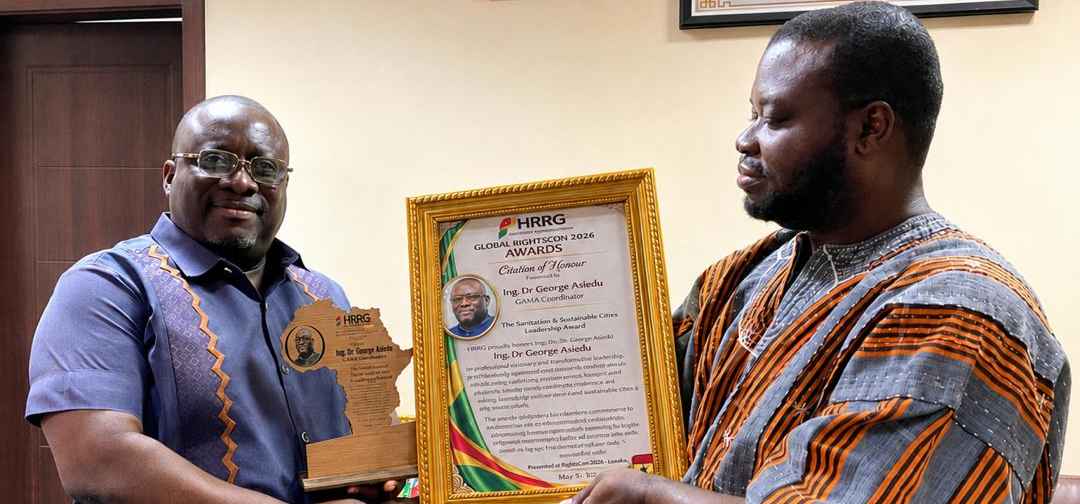
Myself presenting Global RightsShield Award 2026 for Sanitation & Sustainable Cities Leadership to Ing. Dr. George Asiedu, GAMA-SWP Boss
In 2023, a human-interest report on a 15-year-old girl battling typhoid fever while living with her family without a toilet facility in Gbegbeyise, in the Greater Accra Region, began a journey that would become one of the most memorable experiences of my journalism career.
At the time, I was among 30 selected Ghanaian journalists who underwent capacity building in COVID-19 and infectious diseases reporting through the Centre for Science and Health Communication (CSHC), with technical support from faculty members of the School of Communication Studies at the University of Ghana and experienced journalists and editors.
The training was intended to strengthen journalists' capacity to report accurately and responsibly on infectious diseases and public health issues.
For me, however, its significance went beyond the classroom.
It provided an opportunity to sharpen my understanding of health reporting and, more importantly, to appreciate the human stories behind public health challenges.
I would later put that knowledge into practice when I encountered the story of a teenage girl whose family was living without a toilet facility.
I did not know then that the story would eventually attract an institutional intervention, become the subject of a documentary, and travel from Ghana to South Africa for screening on an international platform.
The story of a teenage girl
In June 2023, I published a report titled, “Living without a toilet at home: The traumatic tale of a 15-year-old typhoid fever patient.”
The report focused on a 15-year-old girl who was battling typhoid fever while living with her family in Gbegbeyise without a toilet facility.
What initially appeared to be a health story quickly revealed broader concerns about sanitation, health, privacy, and human dignity.
The absence of a toilet facility was not merely an infrastructure challenge for the family. It affected their everyday living conditions and exposed them to sanitation-related risks.
I considered the circumstances serious enough to warrant public attention and proceeded to document and publish the story.
The report was published by GhanaWeb and subsequently attracted attention from other media platforms.
At the time, I regarded the publication as part of my responsibility as a journalist to give visibility to issues affecting vulnerable people.
I did not, however, anticipate how far the story would travel.
From publication to intervention
The story eventually came to the attention of the Greater Accra Metropolitan Area Sanitation and Water Project (GAMA-SWP).
Ing. Dr. George Asiedu, Coordinator of the project, and his team took notice of the family's circumstances.
The project subsequently intervened, resulting in the provision of a toilet facility for the teenage girl and her family.
For me, that was a defining moment.
The report had moved beyond publication and contributed to drawing attention to a practical problem affecting a vulnerable family.
It reinforced my belief that public-interest journalism can sometimes serve as a bridge between communities experiencing challenges and institutions with the mandate and resources to respond.
From a newspaper report to a documentary
The story did not end with the intervention.
Its impact subsequently led to the production of a documentary highlighting the teenage girl's circumstances, the sanitation challenge confronting her family, and the intervention that followed.
What had started as a written report had acquired a second life through
The documentary allowed the story to reach audiences beyond those who had encountered the original publication.
It also demonstrated to me that the impact of journalism cannot always be measured by the immediate response to a published article.
Sometimes its influence continues to grow in ways the journalist could never have anticipated.
From Ghana to South Africa
The documentary subsequently traveled to South Africa for screening on an international platform.
That moment was particularly meaningful to me.
The story had started with a teenage girl in Gbegbeyise.
It had been published as a health and human-interest report.
It had contributed to an intervention.
It had become a documentary.
And it was now being presented to an international audience.
I found myself reflecting on the remarkable journey of a story that I initially thought was simply my responsibility as a journalist to tell.
A full-circle moment
Three years after the original publication, I had another opportunity to revisit the story.
This time, I was not returning to report on the teenage girl or her family's sanitation challenge.
I was returning to recognise one of the people whose response had helped change their circumstances.
On August 19, 2026, Human Rights Reporters Ghana (HRRG) presented Ing. Dr. George Asiedu with the HRRG Global RightsShield Award for Sanitation & Sustainable Cities Leadership as part of the 2026 HRRG Global RightsShield Awards.
As I presented the award, I reflected on the journey that had started with the 2023 report.
I commended Ing. Dr. Asiedu for responding to the family's plight after the report brought their situation to public attention.
“You did not simply read the story and move on. You saw a vulnerable family in distress and recognised that there was something within your mandate that you could do to change their situation. You acted, and that action made a real difference,” I told him.
Then came the words that, for me, best captured what the intervention meant:
“You did not just build a toilet; you helped restore dignity."
The intervention was about much more than the construction of a physical facility.
It was about giving a family the opportunity to live in a safer and more dignified environment.
It was about reducing a health risk.
It was about privacy.
And, ultimately, it was about recognising the humanity of a teenage girl whose difficult circumstances had been brought to public attention through journalism.
More than a story
The experience changed the way I understand impact journalism.
Before then, I already believed that journalism could inform the public, expose problems, and hold institutions accountable.
But this experience showed me that a story can sometimes become a bridge.
A journalist can identify a problem.
The media can give that problem visibility.
An institution can listen.
And a response can follow.
When these things come together, journalism can produce an impact that goes far beyond readership figures.