
My Frontline Journal: from idea to action.
May 28, 2019
Story

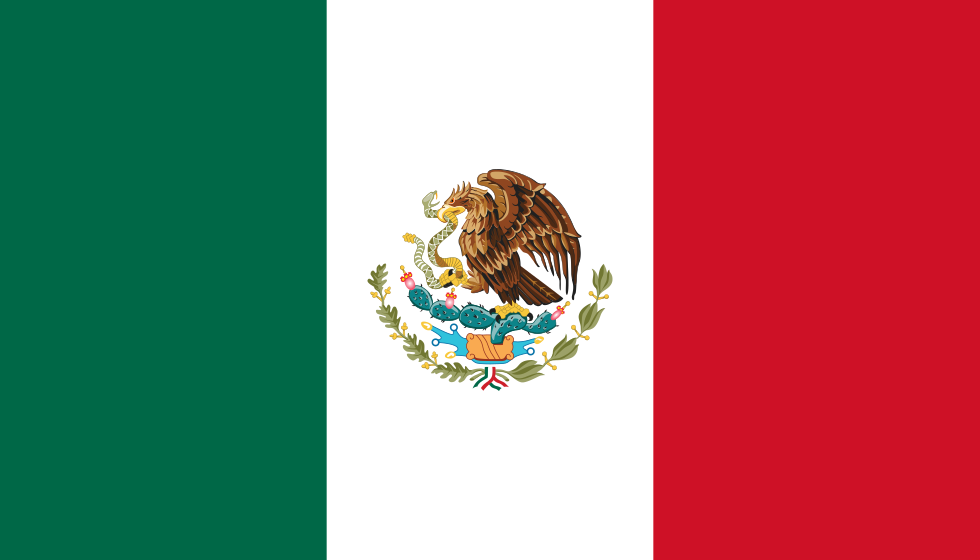
Monday mornings are commonly a burden for middle-class children (and frequently also their parents) who after a relaxing weekend have to wake up early again and go back to school (or their jobs). While I waked up, got a nice, warm breakfast made by my mother every morning, grabbed my lunch for school and was often worried because I hadn’t practiced the demanded hours my violin teacher had told me, millions of children from all around my country didn’t have anything for breakfast, and actually had no idea when they were going to have their next meal or where it was going to come from.
This panorama is the reality for 42% of the total population of Mexico, with a number of urban poor rising up to 49.7 million, who in most cases weren’t able to have a proper training that could have helped them have access to a sufficient paying job, scrutinize through complexity to make good choices, have access to good nutrition to stay – at least a couple of more years – in school, live with proper infrastructure that didn’t limit public services such as water and sanitation, or even internet access (which, in any case, is irrelevant since their limited resources usually prevent them from acquiring tablets or other electronic devices that can improve efficiency or connectivity) – leaving them, in every sense, isolated from the rest of the population.
Globally, where children under 18 will represent more than 60% of the urban population in developing countries by 2030 (Garland, 2007), we have today more than two thirds of youth unemployed, or working in a low-quality, irregular, informal job. And, something that I’ve seen happen in Mexico, is that when young people lack opportunities, they are most probably going to follow a life journey in poverty that as mentioned before, leads to social and economic exclusion.
A couple of years ago I had the opportunity to attend an amazing Summit that brings together young leaders from all around the world to leverage their work and connect them with high level officials called One Young World, and one of the things that I came to realize and that I wasn’t aware of is that even though we are globally facing the biggest challenges of all times, our generation is the most connected, informed and with better resources than any other generation before. This really stunned me and made me search for great initiatives that not only empowered young people to bring up solutions to the world’s biggest problems, but that created local solutions to global issues. And lucky as I was, I found it: The Hult Prize.
This past weekend I witnessed hundreds of young students from all around the world pitching ideas that uniquely delivered business returns and created social impact, to improve connectivity and double the income of the urban poor who currently live in either megacities, slums or refugee camps. They were part of the Hult Prize Regional Finals, the largest student competition that aims to solve the world’s toughest challenges and that took place simultaneously in London, Dubai, Shanghai, Boston and San Francisco on March 12.
The best part, personally, was that for the first time the world had the opportunity to see two Mexican teams in the Final Round of the Regional Competitions. Meaning, that world class leaders that served as judges saw the passion and feasibility of ideas, with proven impact and a pilot program, that Mexican young people had created for their people. These young students are not only engaged completely with their studies to help others, but are aware and intensely sharing the sense of urgency that urban poor poverty represents not only for Mexico, but for our region and the world.
By connecting people, goods, services and capital, these students and now social entrepreneurs have started a journey of life that will definitely change the way urban poor currently live. “Mexicans themselves don’t even trust their own transformation.”, said George Friedman in his most recent article where he speaks about the potential Mexico has and how – despite our own challenges, it could grow in the next years as a great power. Yet, these students have proved the opposite. They are creating a new way of doing business while doing social good and inspiring a whole generation in their country to come up with solutions to break the cycle of poverty. Through the Hult Prize I've found an amazing platform to help, train and empower young people from around my country - and the world - to tackle huge challenges that only seem to get tougher and tougher every time. Yet, I'm confident that young people have the most innovative solutions within themselves and that with just a little bit of help they can achieve great things. I have pledged to continue working for young people and will not stop until every person in my country has access to opportunities that help them reach their full potential.
Garland, A. (2007). Global urban poverty. Setting the agenda. Washington, D.C.: Woodrow Wilson International Center for Scholars.